In modern manufacturing, precision is everything. Industries such as aerospace, automotive, medical, and electronics rely on CNC machining to produce components with exact specifications. Even the smallest deviation can cause a product to fail, making quality testing for CNC machined parts an essential step in the production process. To achieve this level of accuracy, manufacturers depend on metrology.
Metrology is the science of measurement. It provides the tools, standards, and methods used to verify the dimensions and tolerances of machined parts. By integrating metrology into production, manufacturers can ensure every part meets design requirements, reduces waste, and maintains consistent product quality. This article explores how metrology plays a central role in quality testing for CNC machined parts and why it is critical to successful manufacturing.
Understanding Metrology in CNC Manufacturing
Metrology involves measuring and analyzing physical dimensions, geometry, and surface characteristics of manufactured parts. In CNC machining, it is used to confirm that every feature—such as holes, slots, threads, and contours—matches the engineering drawing.
Without accurate measurements, manufacturers would have no reliable way to verify part quality. Metrology establishes a measurable standard, ensuring that all parts conform to strict tolerances. This scientific approach is the foundation of effective quality testing for CNC machined parts.
Key Areas Measured in Metrology
- Linear dimensions (length, width, height)
- Hole diameters and locations
- Surface roughness
- Flatness and parallelism
- Circularity and cylindricity
- Geometric tolerances (GD&T)
These measurements help identify deviations before parts move to assembly or shipping.
Essential Metrology Tools for Quality Testing
A wide range of instruments is used in quality testing for CNC machined parts, from simple hand tools to highly advanced automated systems. The choice of equipment depends on part complexity, required tolerances, and production volume.
Basic tools like calipers and micrometers are suitable for routine checks, while Coordinate Measuring Machines (CMMs) are used for highly precise and complex measurements. Optical systems and laser scanners also allow non-contact inspection for delicate components.
Common Metrology Instruments
- Vernier calipers
- Digital micrometers
- Dial indicators
- Height gauges
- Surface roughness testers
- Coordinate Measuring Machines (CMMs)
- Optical comparators
- Laser scanning systems
Each tool contributes to a comprehensive inspection strategy and helps ensure dimensional accuracy.
How Metrology Improves Accuracy and Consistency
One of the greatest benefits of metrology is its ability to maintain consistent quality across production runs. CNC machines are programmed to cut material precisely, but tool wear, temperature changes, and machine vibrations can affect results. Metrology detects these variations early.
By comparing actual measurements to nominal CAD dimensions, inspectors can identify trends and make adjustments before defects increase. This proactive approach strengthens quality testing for CNC machined parts and minimizes costly errors.
Ways Metrology Enhances Manufacturing
- Detects dimensional drift
- Identifies machine calibration issues
- Reduces scrap and rework
- Maintains process stability
- Verifies repeatability
- Supports continuous improvement
These benefits allow manufacturers to produce high-precision parts with greater confidence.
Coordinate Measuring Machines (CMMs) and Advanced Inspection
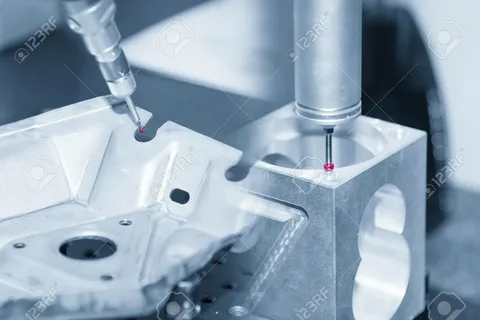
Among all metrology tools, CMMs are considered the gold standard for precision measurement. A CMM uses a probe to touch specific points on a part and compares those measurements to a digital model. It can measure complex geometries with micron-level accuracy.
CMMs are especially useful for intricate aerospace and medical components where tolerances are extremely tight. Their automated capabilities also reduce human error and improve inspection efficiency, making them indispensable for quality testing for CNC machined parts.
Advantages of CMM Inspection
- Extremely high measurement accuracy
- Automated and repeatable processes
- Capability to inspect complex 3D shapes
- Direct CAD comparison
- Detailed inspection reports
- Reduced manual labor
Advanced CMM systems often integrate with manufacturing software for real-time data analysis and reporting.
Metrology Data and Statistical Process Control (SPC)
Metrology does more than verify individual parts; it generates valuable data that can improve the entire production process. Measurements are recorded and analyzed using Statistical Process Control (SPC) to monitor trends and detect process shifts.
SPC helps manufacturers understand whether variations are random or indicate a deeper issue. By combining metrology with SPC, companies can optimize quality testing for CNC machined parts and make data-driven decisions that improve productivity and quality.
Key Metrics Tracked in SPC
- Mean dimension values
- Standard deviation
- Cp and Cpk capability indices
- Process trends over time
- Out-of-tolerance frequency
- Tool wear patterns
These metrics provide insight into machine performance and long-term process capability.
Industry Standards and Compliance Requirements
Many industries require documented proof that parts meet strict standards. Metrology provides traceable measurements that demonstrate compliance with customer and regulatory requirements. Standards such as ISO 9001 and AS9100 depend heavily on robust inspection procedures.
In sectors like medical and aerospace, a single dimensional error can have serious consequences. Comprehensive quality testing for CNC machined parts supported by metrology ensures parts meet all applicable specifications and certification standards.
Standards Supported by Metrology
- ISO 9001 Quality Management
- AS9100 Aerospace Standards
- ISO 13485 Medical Device Quality
- IATF 16949 Automotive Quality
- GD&T per ASME Y14.5
- NIST traceability requirements
These standards reinforce the importance of accurate and documented measurements.
Conclusion
Metrology is the backbone of modern manufacturing and a crucial component of quality testing for CNC machined parts. By using advanced measurement tools and scientific methods, manufacturers can verify dimensions, maintain consistency, and ensure every component meets exact design specifications.
From basic calipers to sophisticated CMMs and SPC systems, metrology provides the accuracy and data needed to optimize production and reduce defects. As industries continue to demand tighter tolerances and higher reliability, the role of metrology in CNC machining will remain more important than ever.