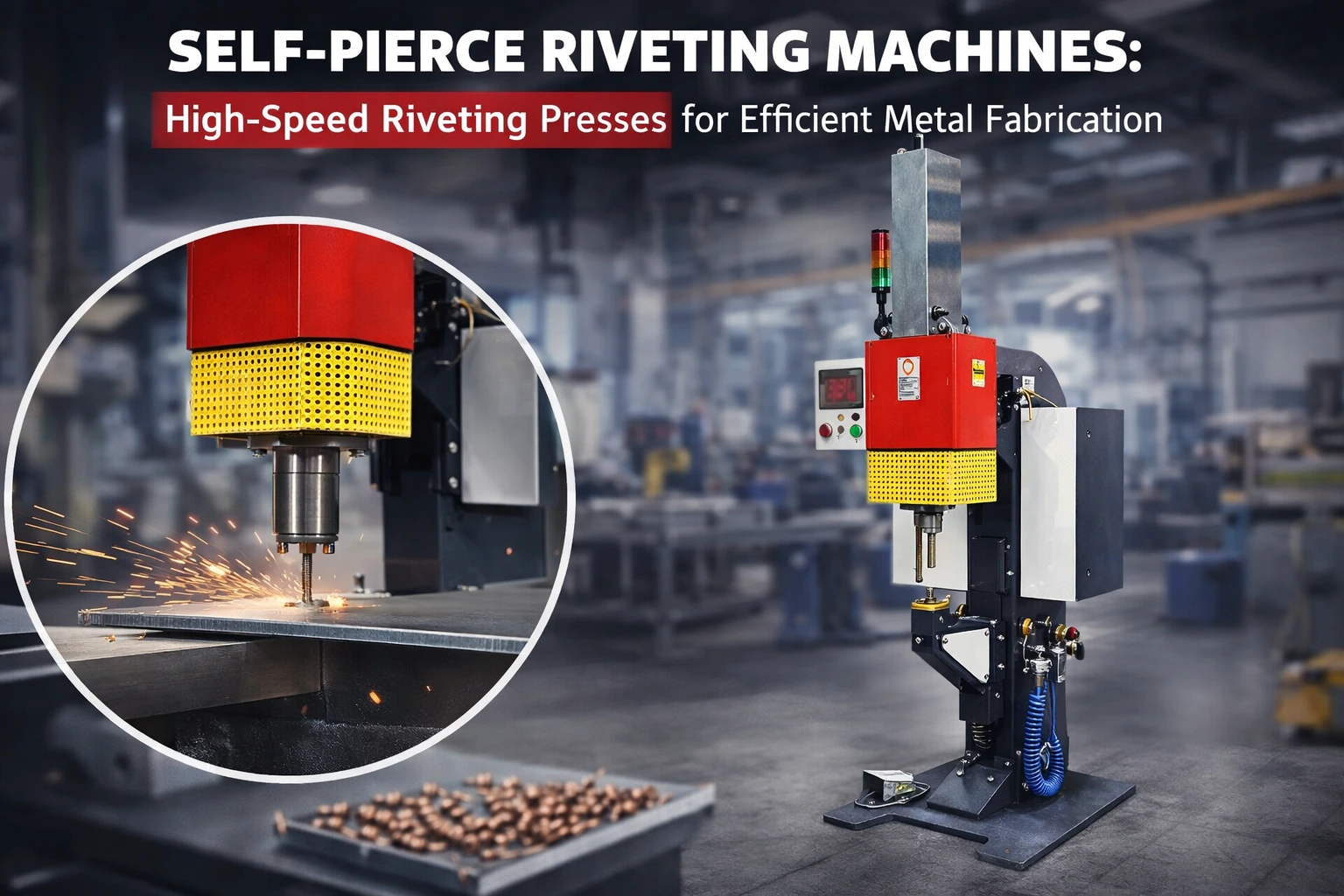
Self pierce riveting (SPR) is an advanced cold-form mechanical joining process widely used in modern manufacturing industries where dissimilar materials, coated sheets, and lightweight structures must be assembled without pre-drilling or heat-based welding. It is especially valuable in automotive, aerospace, rail, and appliance production where strength, repeatability, and material compatibility are critical.
Unlike traditional welding methods, SPR does not require melting of the base materials. Instead, a specially designed rivet pierces the top sheet and mechanically locks into the lower sheet or sheets using a die. This creates a strong, fatigue-resistant joint suitable for multi-material assemblies such as aluminum-to-steel or high-strength steel combinations.
As a global industrial equipment manufacturer, Heron Welder provides advanced self pierce riveting systems designed for high-speed production lines, automation integration, and precision joining requirements across OEM and Tier 1 suppliers.
What is Self Pierce Riveting?
Self pierce riveting is a mechanical fastening technique where a semi-tubular rivet is forced through the top layer of material without fully penetrating the bottom layer. Instead of breaking through both sheets, the rivet flares within the lower material, forming a secure mechanical interlock.
Key Process Steps:
- The sheets are clamped between a punch and a die
- A rivet is driven at high force through the upper sheet
- The rivet pierces only partially into the bottom sheet
- The die causes the rivet legs to flare outward
- A permanent mechanical joint is formed
This process eliminates the need for pre-drilling, heat input, or additional consumables like shielding gas.
How Self Pierce Riveting Works in Industrial Applications
The SPR process relies on precise control of force, alignment, and material deformation. Modern production systems use servo-hydraulic or electromechanical actuators to ensure consistency and repeatability.
Core Components of an SPR System:
- Rivet feeding system
- Punch and die set
- Force-controlled riveting head
- Automation controller
- Monitoring sensors for quality assurance
The ability to integrate SPR into automated production lines makes it ideal for high-volume industries such as automotive body-in-white assembly and EV battery enclosure manufacturing.
Advantages of Self Pierce Riveting
Self pierce riveting offers several advantages over traditional welding and fastening techniques.
1. No Heat-Affected Zone
Because SPR is a cold joining process, it avoids thermal distortion and metallurgical changes in the base materials. This is especially important for aluminum and high-strength steels.
2. Excellent Multi-Material Compatibility
SPR is highly effective for joining dissimilar materials such as:
- Aluminum to steel
- Magnesium alloys
- High-strength steels
- Coated or painted sheets
3. High Structural Strength
The mechanical interlock created by rivet flaring provides excellent shear and peel strength, making it suitable for crash-resistant automotive structures.
4. Fast Cycle Times
SPR can be fully automated, allowing cycle times compatible with high-speed production lines.
5. Clean and Eco-Friendly Process
No fumes, gases, or welding spatter are produced, making it suitable for clean manufacturing environments.
Self Pierce Riveting vs Other Joining Methods
Understanding how SPR compares to other industrial joining technologies helps manufacturers choose the right process.
SPR vs Resistance Spot Welding
Resistance spot welding relies on electrical current and heat to fuse metals, while SPR uses mechanical deformation.
- Spot welding: best for similar metals
- SPR: best for dissimilar or coated materials
- Spot welding: may require surface preparation
- SPR: no surface cleaning or coating removal needed
SPR vs Clinching
Clinching forms a joint by plastically deforming materials without a rivet.
- Clinching: lower joint strength in some applications
- SPR: higher mechanical strength and fatigue resistance
- Clinching: lower cost per joint
- SPR: more versatile for critical structures
SPR vs Bolting
Bolted joints require drilling and manual or semi-automated assembly.
- Bolting: slower assembly process
- SPR: fully automatable and faster
- Bolting: removable joints
- SPR: permanent high-strength joints
Applications of Self Pierce Riveting
Self pierce riveting is widely used across multiple industries that demand strong, lightweight, and reliable joints.
Automotive Industry
SPR is extensively used in vehicle body structures, including:
- Door panels
- Roof assemblies
- Chassis components
- Crash management systems
Electric vehicles (EVs) especially benefit from SPR due to the increasing use of aluminum and multi-material designs.
Aerospace Industry
Aircraft manufacturers use SPR for lightweight structures where fatigue resistance and material compatibility are essential.
Rail Transportation
High-speed trains and rail car bodies use SPR to reduce weight while maintaining structural integrity.
Appliance Manufacturing
Home appliances such as washing machines, ovens, and HVAC systems use SPR for durable sheet metal assemblies.
Industrial Equipment
Heavy machinery, enclosures, and electrical cabinets benefit from SPR’s reliability and clean process.
Key Design Considerations for Self Pierce Riveting
To achieve optimal joint quality, engineers must consider several design factors.
Material Selection
Not all materials behave the same under SPR. Ductility and hardness differences must be evaluated to ensure proper rivet flaring.
Sheet Thickness Ratio
Correct top and bottom sheet thickness ratios are essential for strong interlocking.
Rivet Type and Coating
Rivets are often coated for corrosion resistance and compatibility with specific metals.
Die Design
Die geometry directly influences rivet flaring behavior and final joint strength.
Force Control
Precise force application ensures consistent penetration and avoids material cracking.
Automation and Industry 4.0 Integration
Modern manufacturing increasingly demands intelligent and connected systems. SPR equipment is now commonly integrated into automated production lines with real-time monitoring.
Advanced systems provide:
- Force-displacement monitoring
- Joint quality verification
- Predictive maintenance alerts
- Production data logging
- PLC and robotic integration
These capabilities ensure consistent quality while minimizing downtime and production errors.
As a technology-focused manufacturer, Heron Welder develops SPR solutions designed for seamless integration into smart factories and high-efficiency production environments.
Challenges in Self Pierce Riveting
Despite its advantages, SPR also presents certain challenges:
- Initial equipment investment can be high
- Tool wear requires regular maintenance
- Process optimization is material-specific
- Requires precise alignment in automated systems
However, these challenges are typically offset by long-term productivity gains and reduced rework rates.
Future of Self Pierce Riveting Technology
The future of SPR is closely linked with lightweight manufacturing and electric mobility. As industries continue to shift toward aluminum-intensive and multi-material designs, demand for SPR technology is expected to grow.
Emerging trends include:
- AI-driven quality inspection
- Fully robotic SPR cells
- Hybrid joining systems combining SPR with adhesives
- Lightweight EV structural optimization
Manufacturers investing in SPR today are positioning themselves for next-generation production requirements.
FAQs About Self Pierce Riveting
1. What is self pierce riveting used for?
Self pierce riveting is used to join sheet materials without pre-drilling or welding, especially in automotive, aerospace, and appliance manufacturing.
2. Is self pierce riveting stronger than welding?
In many multi-material applications, SPR can provide equal or superior strength, particularly in fatigue resistance and dissimilar material joining.
3. Can SPR be used on aluminum and steel together?
Yes, SPR is widely used for aluminum-to-steel joints where traditional welding is difficult or impossible.
4. Does self pierce riveting require heat?
No, SPR is a cold mechanical joining process that does not involve heat or melting.
5. Is SPR suitable for automation?
Yes, SPR is highly compatible with automated and robotic production lines, making it ideal for high-volume manufacturing.
Summary
Self pierce riveting has become a critical joining technology for industries transitioning toward lightweight structures, multi-material assemblies, and automated manufacturing systems. Its ability to deliver strong, reliable, and repeatable joints without heat distortion makes it a preferred choice for modern production environments.
With deep expertise in industrial joining technologies and automated manufacturing systems, Heron Welder delivers advanced self pierce riveting solutions tailored to OEMs, Tier 1 suppliers, and large-scale manufacturing operations.
If you are looking to improve production efficiency, enhance joint reliability, or integrate SPR into your automated line, consult Heron Welder today for a customized solution and quotation designed around your manufacturing needs.