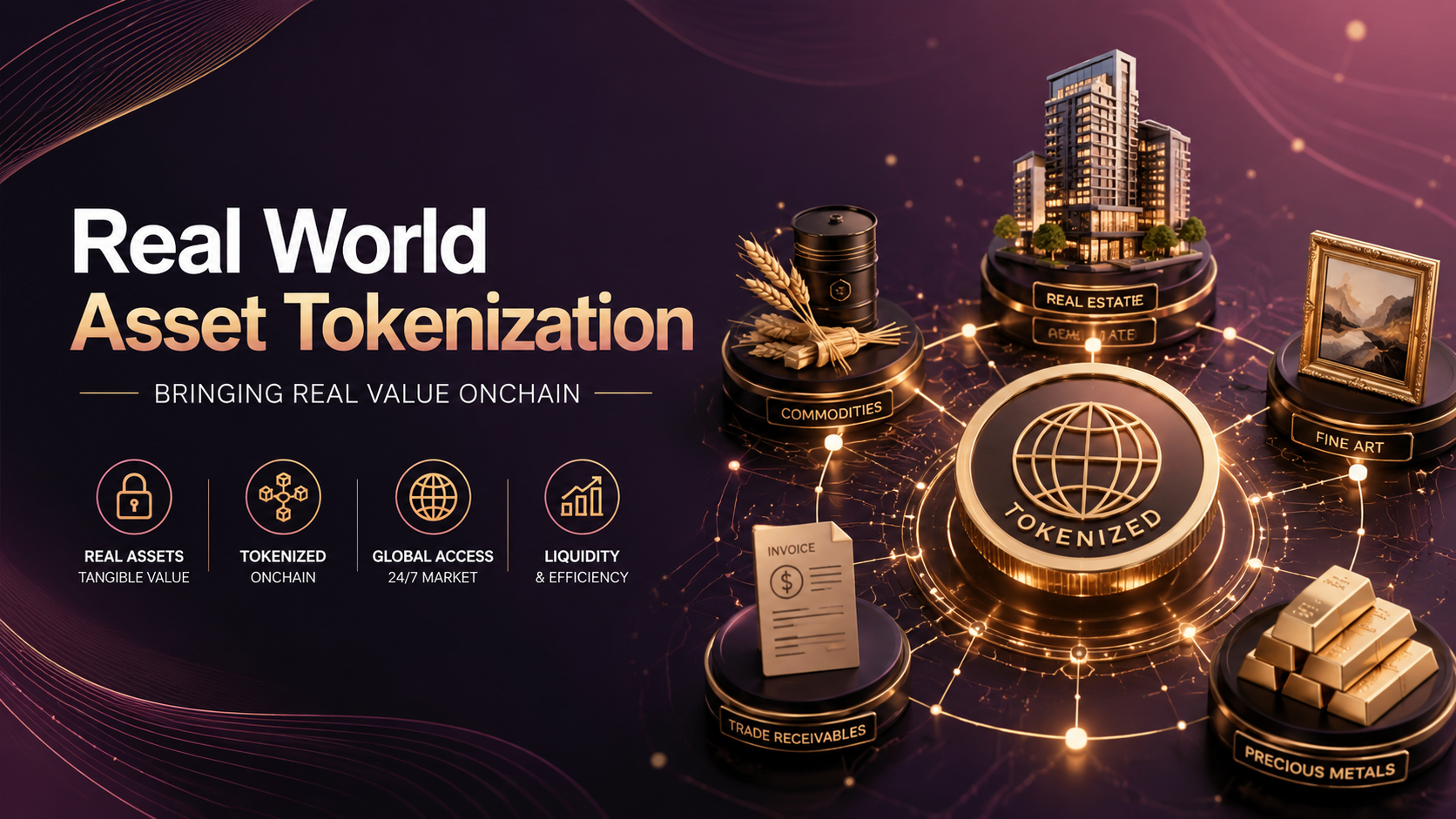
Illiquid asset markets have traditionally been defined by high entry barriers, long holding periods, limited price discovery, and restricted access to buyers and sellers. Assets such as real estate, private equity, fine art, infrastructure, and private credit often remain locked within slow-moving financial structures that depend heavily on intermediaries.
Real-world asset (RWA) tokenization introduces a structural shift in how ownership, transferability, and liquidity can be engineered. By converting rights to physical or financial assets into blockchain-based digital tokens, traditionally illiquid markets can become more divisible, transferable, and accessible. This transformation is not simply a digitization exercise—it represents a redesign of how value moves through financial systems.
Understanding Illiquidity in Traditional Asset Markets
Before examining tokenization, it is important to understand why certain markets are illiquid in the first place.
Illiquidity typically arises from a combination of structural constraints:
- High minimum investment thresholds that exclude retail participation
- Complex legal ownership frameworks requiring intermediaries
- Lack of secondary markets for resale or trading
- Long settlement cycles that slow down transactions
- Difficulty in price discovery due to infrequent transactions
For example, a commercial property or private startup equity stake cannot be easily sold within minutes or hours like publicly traded stocks. Instead, transactions often require weeks or months, extensive legal documentation, and negotiation between limited counterparties. These inefficiencies create capital stagnation, where value is locked but not easily accessible.
What Real World Asset Tokenization Changes at a Structural Level
Real-world asset tokenization converts ownership rights into digital tokens recorded on a blockchain. These tokens can represent fractional ownership, revenue rights, or debt obligations tied to the underlying asset.
At a structural level, tokenization introduces three critical changes:
First, it enables fractionalization, breaking large assets into smaller units of ownership. Second, it introduces programmability, allowing ownership rules and financial logic to be embedded in smart contracts. Third, it enhances transferability, enabling faster and more transparent exchange of asset rights. Together, these changes directly address the core causes of illiquidity.
Fractional Ownership: Breaking Large Assets into Accessible Units
One of the most powerful mechanisms for unlocking illiquid markets is fractional ownership. Traditionally, assets like real estate buildings, infrastructure projects, or private equity funds require large capital commitments. This limits participation to institutional investors or high-net-worth individuals. Tokenization allows these assets to be divided into smaller digital units, each representing a fraction of the underlying value.
For example:
- A commercial property can be divided into thousands of tokens
- A private credit portfolio can be split into revenue-sharing units
- A fine art piece can be fractionalized among multiple investors
This reduces entry barriers significantly and expands the investor base.
As participation increases, demand-side liquidity improves naturally because more market participants can buy and sell ownership stakes.
Secondary Markets: Creating Continuous Liquidity Channels
One of the biggest limitations of illiquid assets is the absence of active secondary markets. Investors are often forced to hold assets until maturity, exit events, or private negotiations. Tokenization enables the creation of digital secondary markets where tokenized assets can be traded more freely. Instead of waiting for months to sell a property share or private equity stake, investors can list tokens on regulated digital marketplaces or decentralized exchanges, depending on compliance frameworks.
This introduces a continuous liquidity cycle, where assets are no longer locked but dynamically tradable. However, liquidity does not automatically become deep; it requires active participation, market-making mechanisms, and regulatory alignment. Still, the structural capability itself represents a major shift from traditional models.
Improved Price Discovery Through Transparent Market Activity
Illiquid markets often suffer from poor price discovery due to infrequent transactions and opaque valuation methods. Tokenization improves this by enabling more frequent trading activity and transparent on-chain records. Every transaction becomes part of a verifiable ledger, allowing participants to observe real-time pricing trends. As trading frequency increases, valuation models become more data-driven rather than speculative or outdated. This helps reduce pricing inefficiencies and improves investor confidence, especially in markets like real estate or private credit where valuations are often subjective.
Reduced Dependency on Traditional Intermediaries
Traditional illiquid asset transactions rely heavily on intermediaries such as brokers, custodians, legal advisors, and transfer agents. These intermediaries increase transaction costs and slow down settlement processes.
Tokenization reduces dependency on these layers by embedding ownership rules directly into smart contracts.
For example:
- Ownership transfers can be executed automatically once conditions are met
- Dividend or yield distributions can be programmatically handled
- Compliance checks can be integrated into token logic
This automation reduces friction and shortens transaction timelines, making asset movement more efficient.
Faster Settlement and Near-Real-Time Transfers
Settlement speed is another critical factor in liquidity. In traditional markets, settlement cycles can take several days due to reconciliation, clearing, and regulatory verification. Tokenized assets can significantly reduce this delay by enabling near-real-time settlement through blockchain infrastructure. Once a transaction is confirmed, ownership records are updated immediately on-chain, eliminating the need for prolonged back-office processes. Faster settlement cycles reduce counterparty risk and increase capital efficiency, both of which contribute to improved liquidity conditions.
Unlocking Previously Inaccessible Asset Classes
Many high-value asset classes remain largely inaccessible due to structural limitations.
These include:
- Private equity and venture capital funds
- Commercial real estate portfolios
- Infrastructure projects such as energy grids or transport systems
- Intellectual property and royalty streams
- Private credit and structured debt instruments
Tokenization opens these markets to broader participation by lowering capital thresholds and enabling fractional exposure.
As a result, capital that was previously locked in exclusive investment vehicles becomes more widely distributed across investor segments.
Global Accessibility and Cross-Border Participation
Illiquid asset markets are often geographically constrained. Regulatory frameworks, capital restrictions, and administrative barriers limit cross-border participation. Tokenization introduces a globally accessible infrastructure layer, where assets can be represented digitally and accessed by investors from different regions (subject to compliance rules). This expands the potential investor pool significantly, which directly improves liquidity conditions. For example, a tokenized real estate asset in one country may attract fractional investors from multiple jurisdictions, increasing demand diversity.
Enhanced Collateralization and DeFi Integration
Another major liquidity unlock comes from the ability to use tokenized assets as collateral in financial systems.
In decentralized finance ecosystems, tokenized assets can be:
- Pledged as collateral for loans
- Used in liquidity pools
- Integrated into yield-generating strategies
This transforms traditionally static assets into active financial instruments. For instance, a tokenized bond or real estate share can be used to access liquidity without requiring full asset liquidation. This creates synthetic liquidity even when secondary market demand is limited.
Operational Transparency and Reduced Risk Premiums
Illiquid assets often carry higher risk premiums due to uncertainty, lack of transparency, and limited market data.
Tokenization reduces these uncertainties by providing:
- Transparent ownership records
- Immutable transaction history
- Automated compliance tracking
- Real-time asset performance data (in some cases)
As transparency improves, perceived risk decreases, which can attract more investors and increase liquidity.
Challenges in Unlocking True Liquidity
While tokenization provides structural solutions, liquidity is not guaranteed. Several challenges remain: First, fragmented platforms can divide liquidity across multiple ecosystems. Second, regulatory uncertainty can limit institutional participation. Third, market depth depends heavily on active buyers and sellers, not just technology. Fourth, custody of underlying physical assets must be reliable and verifiable. Without addressing these factors, tokenization may improve accessibility but not necessarily generate deep liquidity immediately.
The Long-Term Transformation of Illiquid Markets
Over time, real-world asset tokenization is expected to reshape the definition of illiquidity itself. Markets that were once considered static may evolve into dynamic financial ecosystems where ownership is continuously transferable, fractionalized, and programmable.
The long-term impact includes:
- More efficient capital allocation
- Broader investor participation
- Reduced friction in asset transfer
- Greater integration between traditional finance and blockchain systems
This does not eliminate illiquidity entirely, but it significantly reduces its structural limitations.
Conclusion
Real-world asset tokenization helps unlock illiquid markets by addressing the core structural barriers that define them: high entry costs, limited divisibility, inefficient settlement systems, and restricted secondary trading. Through fractional ownership, programmable smart contracts, improved transparency, and global accessibility, tokenization transforms static assets into dynamic financial instruments. However, liquidity creation still depends on ecosystem maturity, regulatory clarity, and sustained market participation. The technology provides the framework, but adoption and integration determine the depth of liquidity that emerges.