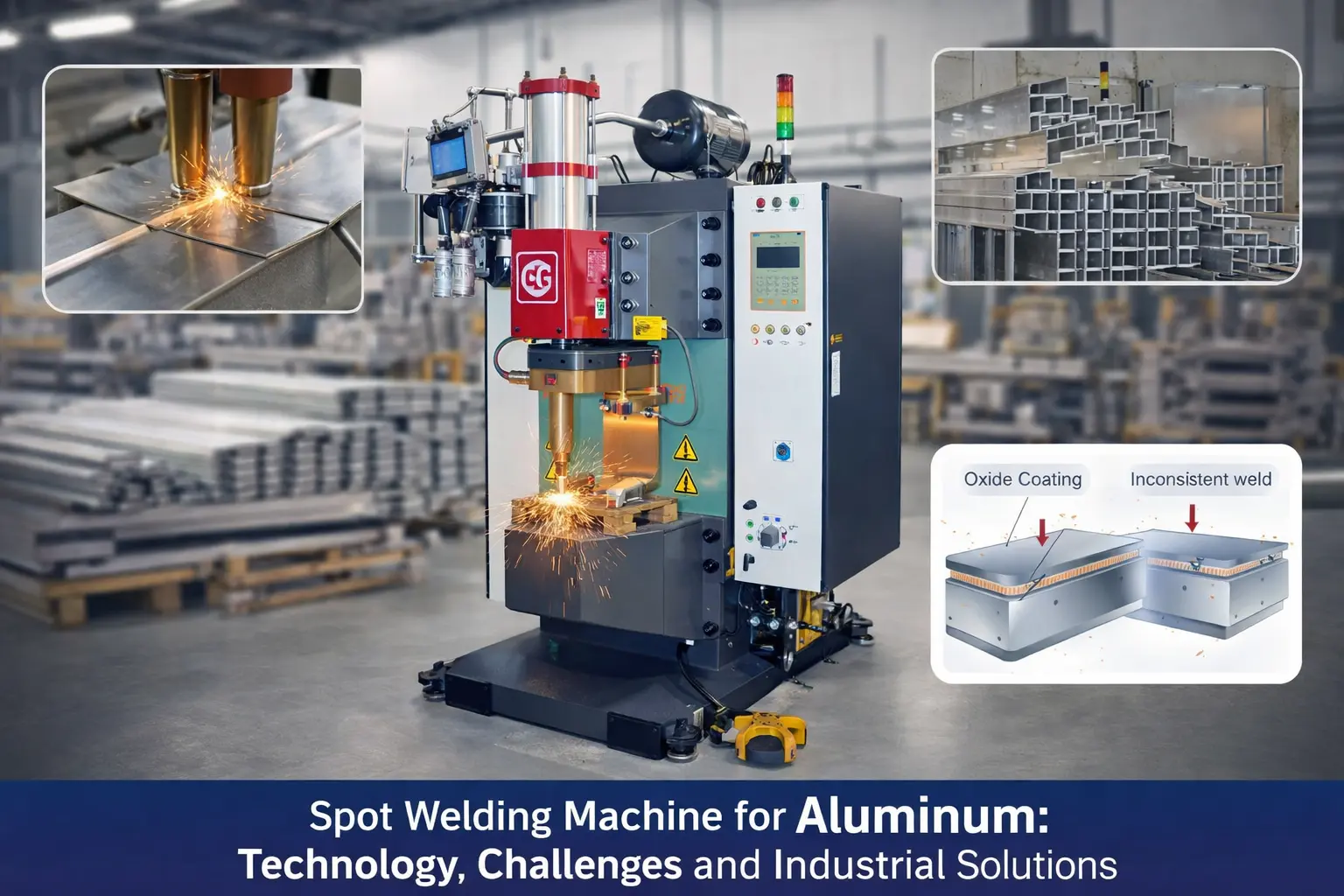
Aluminum has become one of the most widely used materials in modern manufacturing due to its lightweight structure, corrosion resistance, and high strength-to-weight ratio. However, joining aluminum efficiently remains a technical challenge for many OEMs and production engineers. This is where a spot welder for aluminum plays a critical role in delivering reliable, high-speed, and cost-effective joining solutions for industrial applications.
In this article, we explore how aluminum spot welding works, its challenges, best machine technologies, industrial applications, and why advanced resistance welding systems—such as those developed by Heron Welder—are transforming aluminum assembly lines worldwide.
Understanding Spot Welding for Aluminum
Spot welding is a resistance welding process where heat is generated by electrical resistance at the interface of two metal sheets. Pressure is applied through copper electrodes, and a strong weld nugget is formed when current passes through the material.
When applied to aluminum, the process becomes more complex compared to steel due to aluminum’s unique properties:
- High electrical conductivity
- Rapid heat dissipation
- Strong oxide layer on the surface
- Lower melting point compared to steel
These factors require precise control of current, force, and time, making a specialized spot welder for aluminum essential for consistent results.
Why Aluminum Is Challenging to Spot Weld
1. High Conductivity
Aluminum disperses electrical current quickly, meaning more energy is required to generate sufficient heat at the weld point.
2. Oxide Layer Formation
A natural oxide layer forms instantly on aluminum surfaces, acting as a barrier and increasing contact resistance inconsistently.
3. Electrode Wear
Aluminum tends to stick to electrodes, causing faster wear and reducing weld consistency over time.
4. Heat Management Issues
Because aluminum dissipates heat rapidly, maintaining a stable welding temperature window is difficult without advanced control systems.
These challenges demand high-performance resistance welding systems with adaptive parameters and intelligent process control.
How a Spot Welder for Aluminum Works
A modern aluminum spot welding system uses a controlled sequence of electrical and mechanical actions:
Step 1: Electrode Contact
Copper alloy electrodes clamp the aluminum sheets under high pressure to ensure proper contact.
Step 2: Current Application
A high electrical current passes through the joint. Due to resistance at the interface, heat is generated.
Step 3: Nugget Formation
The aluminum reaches its plastic state and begins to fuse at the contact point.
Step 4: Cooling and Solidification
Pressure is maintained as the weld cools, forming a solid, durable weld nugget.
Advanced systems include feedback control to adjust current and pressure in real time, ensuring uniform weld quality across production batches.
Types of Spot Welding Technologies for Aluminum
1. MFDC Spot Welding Machines
Medium Frequency Direct Current (MFDC) systems are widely used for aluminum welding because they:
- Provide stable energy output
- Reduce heat distortion
- Improve energy efficiency
- Allow precise weld control
2. Capacitor Discharge Spot Welders
These machines deliver high peak current in a very short time, making them suitable for thin aluminum sheets and delicate components.
3. Servo-Controlled Spot Welding Guns
Servo systems ensure precise electrode force control, which is critical when working with soft aluminum materials.
4. Automated Robotic Spot Welding Systems
For high-volume manufacturing, robotic systems ensure repeatability, speed, and consistent weld quality in automotive and appliance production lines.
Industrial Applications of Aluminum Spot Welding
A high-quality spot welder for aluminum is essential in several industries:
Automotive Manufacturing
- Body-in-white assembly
- EV battery tray welding
- Lightweight chassis components
Aerospace Industry
- Aircraft interior panels
- Lightweight structural assemblies
- Precision aluminum frameworks
Electrical & Energy Sector
- Busbars and conductor connections
- Battery pack manufacturing
- Enclosure systems
Consumer Appliances
- Refrigerator panels
- Air conditioning housings
- Kitchen appliance shells
Transportation & Rail
- Aluminum car body structures
- Lightweight panel assemblies
The demand for aluminum welding continues to grow as industries prioritize lightweight design and energy efficiency.
Key Features of an Ideal Spot Welder for Aluminum
When selecting a machine for aluminum welding, manufacturing engineers and OEMs should consider the following features:
1. High Precision Current Control
Ensures stable heat generation despite aluminum’s conductivity.
2. Adaptive Welding Parameters
Real-time adjustment of welding time, force, and current improves consistency.
3. Strong Electrode Cooling System
Prevents overheating and extends electrode lifespan.
4. Programmable Welding Profiles
Allows operators to store and reuse optimized welding settings.
5. Automation Compatibility
Integration with robotic arms and production lines for scalable manufacturing.
Best Practices for Aluminum Spot Welding
To achieve high-quality welds, manufacturers should follow these industry best practices:
Surface Preparation
Proper cleaning to remove oil, dirt, and oxide layers improves weld quality significantly.
Electrode Maintenance
Regular dressing and replacement of electrodes prevent inconsistent welds.
Optimized Welding Parameters
Each aluminum grade and thickness requires customized welding settings.
Consistent Pressure Application
Stable electrode force ensures uniform nugget formation.
Monitoring and Quality Control
Use real-time monitoring systems to detect defects and ensure production reliability.
Why Advanced Systems Matter in Aluminum Spot Welding
Traditional spot welding machines often struggle with aluminum due to its unstable welding window. Modern systems—such as those engineered by Heron Welder—solve this problem through:
- Intelligent welding control systems
- High-efficiency MFDC technology
- Precision servo-driven electrode force
- Integrated automation-ready platforms
These technologies allow manufacturers to achieve:
- Higher production efficiency
- Lower defect rates
- Reduced operational costs
- Consistent weld quality in mass production
For OEMs and industrial manufacturers, investing in advanced aluminum spot welding technology directly improves product reliability and long-term competitiveness.
Future of Aluminum Spot Welding in Industry 4.0
With the rise of smart factories and Industry 4.0, spot welding is evolving into a fully digitalized process. Future-ready systems include:
- AI-based weld quality prediction
- IoT-enabled machine monitoring
- Automated parameter optimization
- Cloud-based production tracking
These innovations allow manufacturers to reduce downtime, improve traceability, and ensure zero-defect production standards.
FAQs: Spot Welder for Aluminum
1. Can aluminum be spot welded easily?
Aluminum can be spot welded, but it requires specialized equipment due to its conductivity and oxide layer. Standard steel welders are not suitable.
2. What type of spot welder is best for aluminum?
MFDC spot welding machines and servo-controlled systems are most effective for aluminum applications.
3. Why is aluminum harder to weld than steel?
Because aluminum conducts heat and electricity rapidly, making it harder to maintain consistent weld temperatures.
4. Is spot welding strong enough for aluminum structures?
Yes, when done with proper parameters and advanced machines, spot welds can achieve high structural strength suitable for automotive and industrial use.
5. How do I improve aluminum spot weld quality?
Focus on surface cleaning, optimized welding parameters, electrode maintenance, and using modern adaptive welding systems.
Conclusion
A spot welder for aluminum is not just a machine—it is a precision manufacturing solution that enables industries to work with one of the most important lightweight materials in modern engineering. However, achieving consistent, high-strength aluminum welds requires advanced control systems, automation integration, and deep process expertise.
Manufacturers that invest in modern resistance welding technologies gain a significant advantage in productivity, quality, and operational efficiency.
Request a Customized Welding Solution
Heron Welder specializes in advanced resistance welding systems, including aluminum spot welding machines designed for high-performance industrial applications. Whether you are an OEM, automation integrator, or production facility, Heron provides tailored solutions to meet your exact manufacturing requirements.
Contact Heron Welder to request a consultation or customized quote and upgrade your aluminum welding production with precision-engineered technology.