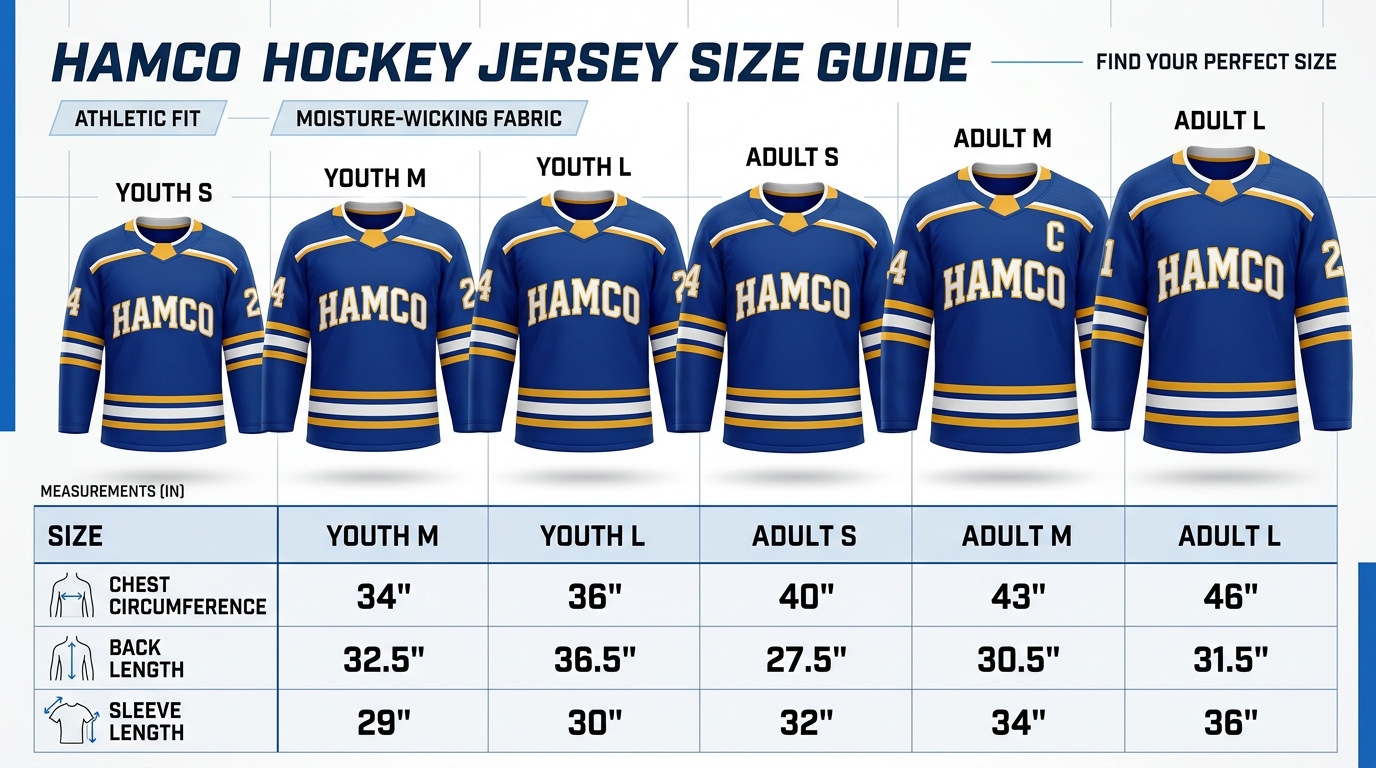
Most parents new to youth hockey run into the same surprise the first time they shop for their kids’ gear. The jerseys their child wears for hockey run dramatically larger than typical clothing sizes. A youth medium hockey jersey looks more like a small adult shirt. The team coordinator hands them a size chart and asks for a chest measurement. The price tag on a quality custom jersey reflects real construction. And somewhere in the middle of all this confusion, the parent realizes they have no idea how to buy a hockey jersey that will fit properly without ordering something their child will outgrow within months. The fix is understanding how the hockey jersey size chart actually works and following a few specific principles that hockey parents have been quietly figuring out for generations.
Hamco Sports has guided hundreds of hockey families through this exact decision over the years. The patterns are clear. Parents who take time to understand sizing fundamentals end up with gear that fits properly and performs well across the full season. Parents who rush through this step often end up with jerseys that swim on small players or restrict bigger players who needed more room. The good news is that getting the sizing right is much easier than most parents assume once they understand the basics.
Why Hockey Jersey Sizing Is Different From Every Other Youth Sport
Hockey jerseys are designed to fit over a substantial layer of equipment. Shoulder pads. Elbow pads. Chest protection. Hip pads. The jersey must accommodate all of this gear while still allowing full range of motion for skating, stickhandling, shooting, and physical contact along the boards. This means hockey jerseys run two to three sizes larger than typical clothing.
A child who wears a medium t shirt off the ice often needs a large or extra large jersey for game play. The dimensions listed on a hockey jersey size chart represent the actual chest measurement of the jersey, not a typical clothing size. Reading a hockey size chart like a standard shirt size chart is the single most common mistake first time hockey parents make.
Goalie jerseys add another layer of complexity. Goalie cuts are even larger than skater cuts to accommodate goalie arm pads, which means goalies typically order at least one full size larger than they would for a regular position jersey.
What a Hockey Jersey Size Chart Should Tell Parents
A useful hockey jersey size chart provides four specific pieces of information for every available size.
The first is the actual jersey chest dimension. This is the measurement across the chest of the jersey itself, taken laid flat. Quality charts list this number explicitly so parents can compare it against jerseys their child already owns.
The second is the body length. Hockey jerseys are cut longer than typical shirts to ensure proper coverage during heavy skating motion. The body length tells parents how the jersey will sit on their child’s torso.
The third is the sleeve length. Hockey players need their jerseys to clear their gloves without bunching or restricting wrist motion. Longer sleeves work for players with longer arms or those who prefer more coverage.
The fourth is whether the size accommodates equipment or fashion wear. Some charts include a separate guide for fans wanting jerseys for casual wear rather than on ice play, which usually means going one size down from the standard playing size.
How Parents Should Measure for a Youth Hockey Jersey
Three steps make hockey jersey measuring straightforward for parents.
First, find a hockey jersey that already fits your child well over their normal equipment loadout. Lay it flat on a smooth surface, stretched without wrinkles. Measure across the chest from armpit to armpit. That number, doubled if needed, gives you the actual chest dimension to compare against the size chart.
Second, measure the body length from the bottom of the collar straight down to the hem. This tells you whether you need a longer or shorter cut for your child’s torso.
Third, when in doubt, size up rather than down. A jersey that is slightly large still allows full motion and proper equipment coverage. A jersey that is too small restricts movement and may ride up during play.
For growing players, sizing up by one full size can extend the useful life of the jersey across a longer period. Just be careful not to size up too aggressively. Oversized jerseys can flap awkwardly during skating, which creates handling issues during games.
How Hamcospo Approaches Youth Hockey Jersey Sizing
Hamcospo offers a flexible sizing approach designed specifically for custom team orders, including youth programs. Sizing covers youth through adult ranges, with custom sizing available for outliers on the roster. Goalie cuts are available with the wider sleeve openings goalies need. The design team also provides fabric and size samples for buyers who want to confirm fit before placing larger team orders.
Every uniform piece uses lightweight performance polyester with moisture wicking properties. Every design is fully sublimated, which keeps colors and graphics intact through full seasons of physical hockey use. Reinforced stitching at the shoulders and elbows handles the demands of contact sport. There are no minimum orders on most products. Free mockups arrive within twelve hours. Unlimited revisions are included at no cost.
Parents and coaches can browse the full custom ice hockey uniforms collection to outfit a complete team. The catalog covers full game day jerseys, socks, and complete uniform packages. Standard production runs two to three weeks, with rush options available for tight deadlines.
For programs that want the convenience of an all in one home kit project, the custom ice hockey home uniforms bundle includes both jersey and matching shorts as a coordinated package, with consistent design language across both pieces.
Why This Matters Now
Hockey continues to grow rapidly across the United States. According to the USA Hockey membership statistics, total membership recently surpassed 577,000 across players, coaches, and officials, with youth registration setting all time highs. The success of Team USA in international competition continues to push youth participation upward, and new programs continue to launch in non traditional hockey markets across the southern and western United States.
Every one of those programs needs uniforms that fit properly. A thoughtful approach to the hockey jersey size chart at the start of the process saves parents from headaches later. The investment in time is small. The payoff in fit, comfort, and player confidence across the season is significant.
Conclusion
Hockey is one of the most equipment intensive youth sports in America. Parents who take time to understand the hockey jersey size chart approach buy gear with confidence rather than crossing their fingers and hoping for the best. The investment in learning the basics is small relative to the comfort and performance benefits the right fit delivers across full seasons of play. For parents and coaches handling youth hockey jersey purchases, working with a real custom hockey supplier like Hamcospo is one of the smartest moves you can make. The result is gear that fits cleanly, performs well, and represents the team properly for years of dedicated youth hockey play.